
“Our goal is to enable multiple robots to work as a team to perform complex real-world tasks. By designing theories and algorithms to control teams of robots, we envision autonomous agents to help human workers in many applications including agriculture, environmental monitoring, security, or disaster response."
Robotics, Mechatronics, and Control
Robotics, mechatronics, and control engineering research at Mason delves into next-generation medical devices, autonomous air and water vehicles, and the use of robotics in shepherding manufacturing and supply chain solutions of the future.
Featured faculty conducting research in robotics, mechatronics, and control include:
- Pilgyu Kang runs the Micro/Nano Mechanics and Photonics with Nanomaterials Laboratory where he conducts fundamental research on micro/nanoscale mechanics and photonics with nanomaterials for innovations in nanobiosensors. Researchers explore broad fields including nanophotonics, optofluidic, optoelectronics, and plasmonics to create innovations in advanced materials and manufacturing for high-performance, low-cost sensor devices. The research aims to develop advanced, high-performance materials with new functionalities in mechanical, optical, and electrical properties.
- Leigh McCue runs the Vessel Dynamics Laboratory which capitalizes on George Mason University’s unique waterfront facility at the Potomac Science Center. The research team’s focus is on computational and experimental studies to better understand the dynamics and hydrodynamics of manned and unmanned vessels.
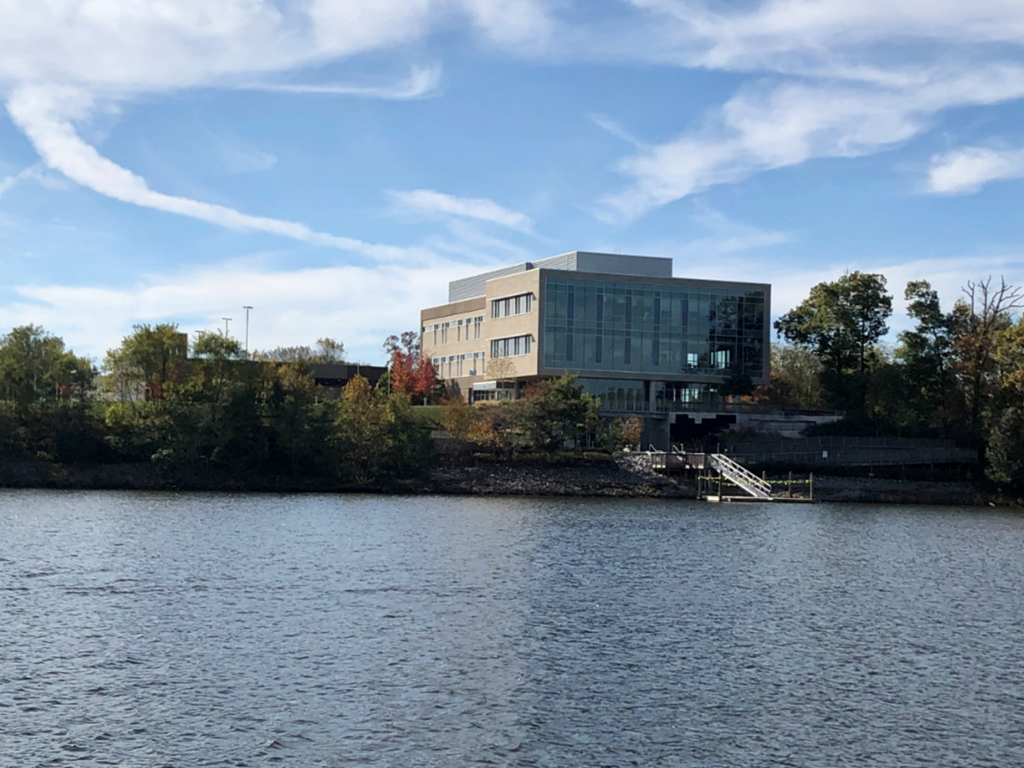
Vessel Dynamics Laboratory located at George Mason University's Potomac Science Center with a unique waterfront facility.
- Quentin Sanders runs the intelligent assistive technology, neuromuscular control and physiology, Wearables, and Rehabilitation Robotics Laboratory or the ImPoWeR Lab. Research in the ImPoWeR lab focuses on developing robotic and prosthetic devices to enhance the quality of life of individuals who have experienced a neurological injury or amputation.
- Daigo Shishika works in the general area of autonomy, dynamics and controls, and robotics. His work has focused on multi-agent systems including animal groups and swarms of autonomous vehicles. Learn more at his research group website.