
“Water and energy systems are intricately interconnected. Our research interests lie in the areas of materials design, advanced manufacturing, and device fabrication to address the integrated challenges around the energy nexus.”
Mechanics, Materials, and Manufacturing
Mason's Department of Mechanical Engineering has significant core strength in engineering mechanics, materials science, and advanced manufacturing. Our faculty have diverse and interdisciplinary research areas including advanced/additive manufacturing, composites, polymers, nanomaterials, solar cells, water treatment technologies, micro/nanoscale mechanics and photonics, nanobiosensors, fatigue, corrosion, tribology, surface engineering, and nano/microscale transport phenomena.
Featured faculty conducting research in mechanics, materials, and manufacturing include:
- Mehdi Amiri is the PI of the Reliability and Mechanics of Failure Laboratory which investigates how materials break under stress. The overarching theme of this research group is to explore the effects of complex microstructure on emergent physical properties in engineering materials. Exquisite control over microscopic properties, such as local elastic anisotropy or the geometry and topology of the microstructure, enables the design of functional local mechanical properties.
- Shay Bagheri runs the Advanced Materials and Manufacturing Laboratory which focuses on manufacturing and analysis of new emerging and multifunctional materials. The main research outcome of this lab is the synthesis of additively manufactured materials based on high-temperature and high-performance polymers as well as biodegradable composites and fibers. These new emerging materials have applications in many industries, especially in textile, energy, and biomedical. The lab is equipped with 3D printers for high-temperature polymers, composites compounders, speed mixers, abrasion testers, injection molding machines as well an Electromechanical Universal Test Machine.
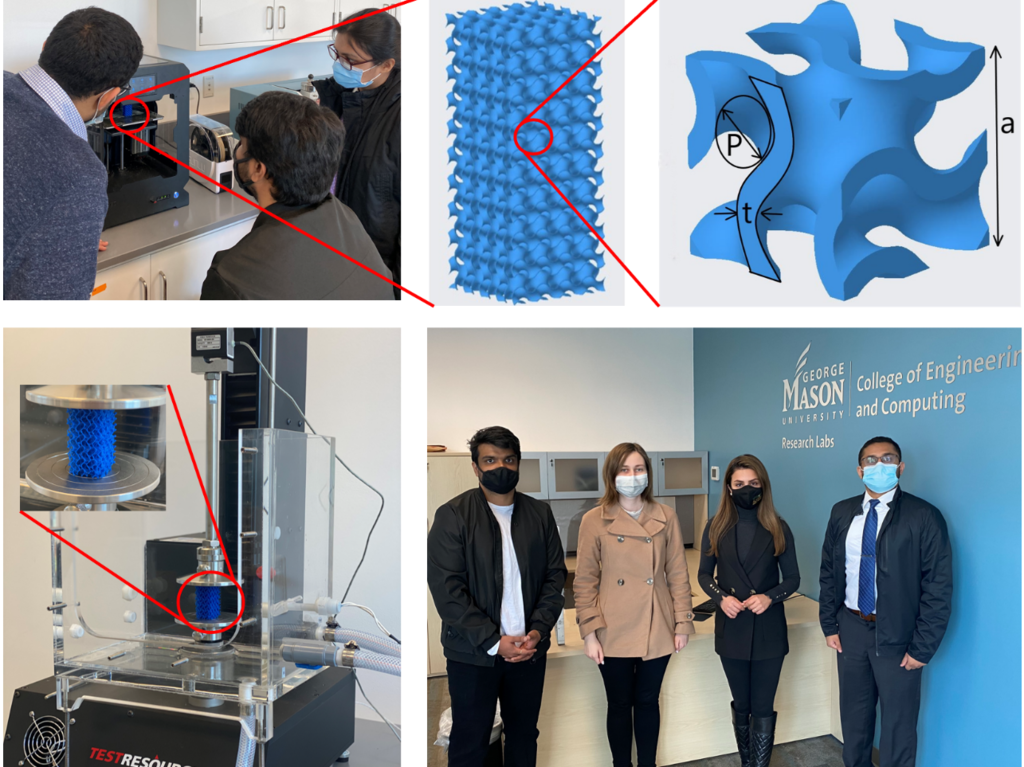
Right bottom image: Kunal Gide, PhD student (left), Violetta Rostobaya and Aditya Pulipaka, undergraduate students, workings with assistant professor Shay Bagheri, principal investigator of Advanced Materials and Manufacturing Lab to design and develop multifunctional materials.
- Ali Beheshti directs the Tribology and Surface Mechanics Laboratory. In this lab, researchers investigate surface and interfacial mechanics as well as friction and wear phenomena from nano to macro scales. The research seeks to reduce energy and material consumption in systems with moving components operating especially in harsh environments (e.g., very high temperatures). The equipment in this lab will enable researchers to perform precise friction and wear tests at temperatures up to 2000 ºF. In addition, the scientists will explore new techniques to improve the wear resistance of new materials (e.g., additively manufactured polymers/metals).
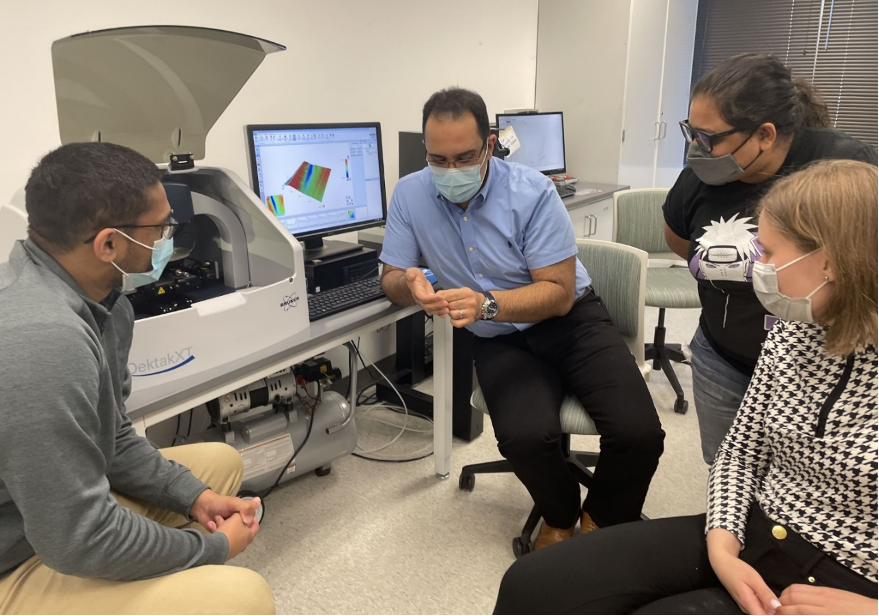
Manisha Tripathy, PhD student (right standing), Violetta Rostobaya, undergraduate student (right), and Aditya Pulipaka, undergraduate student (left) work with assistant professor Ali Beheshti, principal investigator of Mason's Tribology and Surface Mechanics Lab, on research that focuses on studying contact behavior and surface damage of advanced 3D printed alloys.
- Pei Dong and the Dong Group have strong interests in the following areas: advanced materials synthesis (nanomaterials, polymer, and their hybrid and hierarchical composites); advanced materials enabled energy devices (flexible solar cells and integrated energy devices); advanced material enabled water treatment technologies (water desalination and water decontamination). Researchers are also working on multiple interdisciplinary topics.
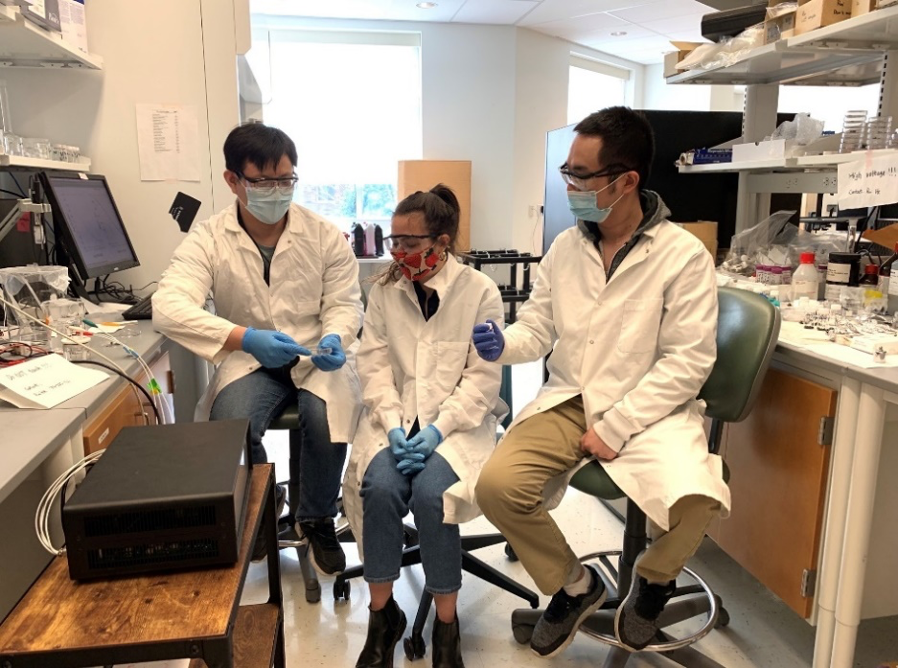
Rui He, PhD student (Left), Crystal Bowers, undergraduate student (middle), and Xiaozhou Huang, PhD student (right) work on advanced materials design, synthesis and characterization.
- Pilgyu Kang runs the Micro/Nano Mechanics and Photonics with Nanomaterials Laboratory where he conducts fundamental research on micro/nanoscale mechanics and photonics with nanomaterials for innovations in nanobiosensors. Researchers explore broad fields including nanophotonics, optofluidic, optoelectronics, and plasmonics to create innovations in advanced materials and manufacturing for high-performance, low-cost sensor devices. The research aims to develop advanced, high-performance materials with new functionalities in mechanical, optical, and electrical properties.
- Jeffrey Moran is the principal investigator for the Nano/micro-scale Transport Engineering Laboratory. This lab studies the fundamental physics underlying nano and microscale transport phenomena in fluids, especially involving interfaces and electric fields. Dr. Moran's work will enable the design of better sustainable energy systems, more energy-efficient and affordable wastewater treatment methods, and even improved treatments for diseases like cancer.